

Project Overview
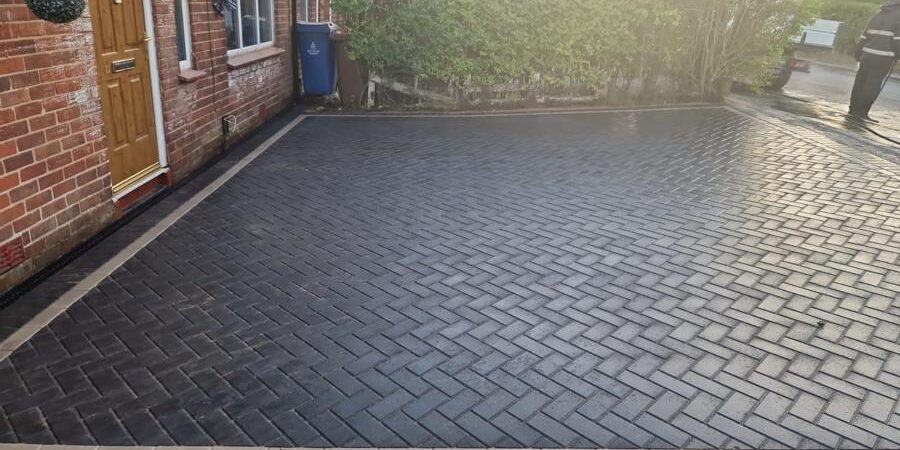
Meadow Drives recently completed this charcoal block paved driveway installation for a property in Blackburn. The project transformed an underused front garden into an attractive and practical off-road parking area, substantially improving both access and kerb appeal.
The completed driveway features dark charcoal paving laid in a traditional 45-degree herringbone pattern. Contrasting light-grey borders and charcoal edging define the installation, while carefully positioned drainage channels help manage surface water around the property.
Project Details
- Location: Blackburn
- Materials Used: Block Paving, Indian Sandstone Patio & Steps
- Completion Date: 25/10/25
- Duration: 5 Days
Gallery
Before
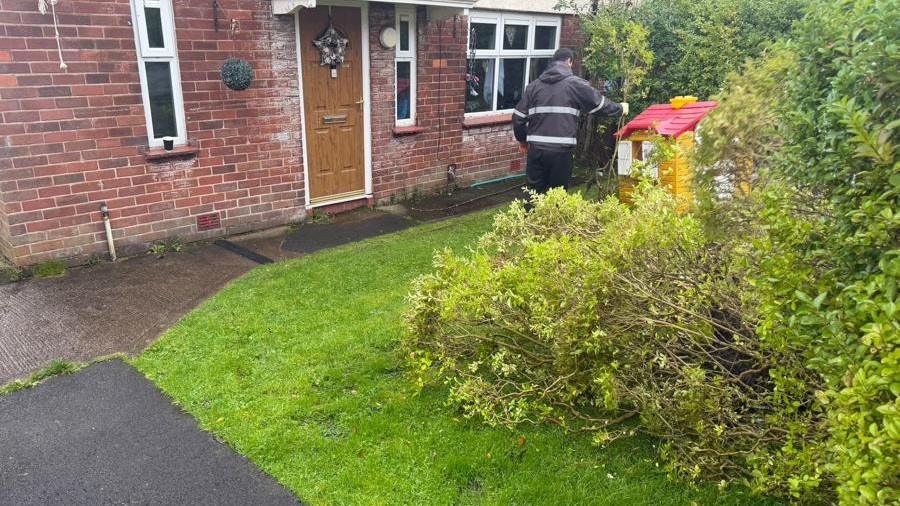
The front of the property consisted mainly of lawn, shrubs, mature hedging and several narrow pathways. Although the space was relatively large, its divided layout provided little usable off-road parking and required regular garden maintenance.
After
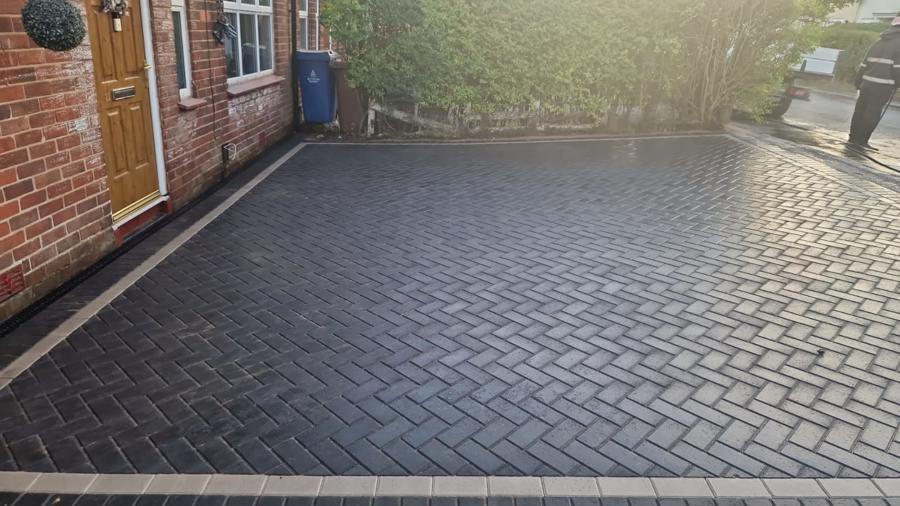
The area has been transformed into a spacious charcoal block paved driveway laid in a 45-degree herringbone pattern. Contrasting light-grey and charcoal borders frame the surface, while integrated drainage helps control rainwater around the property.
The retained greenery provides a natural backdrop, giving the homeowner the additional parking they needed without completely removing the character of the original front garden.
The Original Front Garden
Before work began, much of the available frontage consisted of grass, established shrubs and mature hedging. Narrow concrete and tarmac pathways provided pedestrian access, but there was no substantial driveway or practical off-road parking area.
The vegetation also divided the space into several smaller sections, preventing the homeowner from making full use of the available frontage.
The aim was to clear and reorganise the area while retaining selected boundary hedging and a smaller section of lawn. This would provide significantly more parking space without removing all the greenery from the front of the property.
Clearing the Site
The first stage involved removing the shrubs, unwanted sections of hedge and the lawn within the proposed driveway area. Existing pathways and unsuitable surface materials were also broken up and cleared.
A compact excavator was used to remove the topsoil and excavate the site to the required depth. All vegetation, soil and waste materials were taken away to leave a clear area ready for the driveway foundations.
Particular care was taken around the property, neighbouring boundaries and retained hedging.
Forming the Levels and Drainage
Once excavation was complete, the new levels and falls were established. Correct levels are essential on any driveway, helping water travel towards the drainage system rather than collecting against the house or forming puddles across the paving.
Linear drainage channels were installed alongside the property to intercept surface water before it could reach the walls and doorways.
The layout was also designed to connect neatly with the pavement and existing pedestrian access while providing a smooth transition onto the new driveway.
Installing the Sub-Base
A strong compacted aggregate sub-base was installed across the excavated area. The material was spread evenly and mechanically compacted in layers to create a firm foundation capable of supporting regular vehicle traffic.
This groundwork is one of the most important stages of a block paved driveway installation. A properly prepared base helps prevent settlement, movement and uneven sections from developing over time.
The levels were checked throughout compaction to ensure the correct falls were maintained.
Contrasting Block-Paved Borders
The driveway was framed with a combination of charcoal and light-grey paving blocks.
Dark charcoal blocks were laid as a soldier-course edge around the perimeter, providing a strong structural restraint for the main paving. A contrasting light-grey band was then incorporated inside the darker edging.
The light border adds definition and prevents the large charcoal surface from appearing too uniform. It also creates a clear outline around the driveway, pathway and front of the property.
The border blocks were carefully positioned before the central paving was installed, establishing the finished shape and dimensions of the driveway.
Laying the Charcoal Herringbone Paving
The main driveway was completed using dark charcoal rectangular blocks laid in a 45-degree herringbone pattern.
Herringbone is particularly suitable for driveways because the interlocking arrangement distributes vehicle loads across the surface and helps resist movement under braking and turning.
Each block was laid closely against the next over a carefully prepared laying course. Precise cuts were made around the borders, drainage channels, walls and retained landscaping to create clean edges without unnecessarily large joints.
The deep charcoal colour gives the driveway a smart, contemporary appearance and works well against the property’s traditional red brickwork.
Compacting and Jointing the Driveway
After all paving and edge cuts had been completed, kiln-dried jointing sand was brushed across the surface and into the joints between the blocks.
The driveway was then mechanically compacted to bed the paving securely into the laying course. Additional jointing sand was applied where required, helping lock the individual blocks together and stabilise the completed surface.
The area was finally cleaned and inspected to ensure consistent levels, secure edging and an even finish throughout.
The Finished Driveway
The completed driveway has made considerably better use of the available frontage. What was previously a divided garden with limited practical access is now a spacious, hard-wearing parking area.
The charcoal herringbone paving creates a strong and consistent main surface, while the light-grey border introduces contrast and highlights the shape of the installation.
Selected lawn and boundary hedging were retained to soften the appearance of the driveway and preserve some of the garden’s established character.
Block Paved Driveways in Blackburn
If you are considering a new block paved driveway in Blackburn or the surrounding Lancashire area, Meadow Drives can manage the complete installation—from site clearance and excavation through to drainage, foundations, borders and paving.
Contact Meadow Drives today to arrange a free, no-obligation quotation.
Full Project Gallery
Work Completed
- Removal of unwanted shrubs and sections of hedging
- Excavation of the existing lawn and pathways
- Removal and disposal of soil and unsuitable materials
- Formation of the required driveway levels and falls
- Installation of linear surface-water drainage
- Installation and mechanical compaction of the sub-base
- Preparation of the block-paving laying course
- Construction of charcoal perimeter edging
- Installation of contrasting light-grey borders
- Charcoal paving laid in a 45-degree herringbone pattern
- Precision cutting around walls, borders and drainage
- Jointing with kiln-dried sand
- Final compaction, cleaning and inspection